
The brake pad mixer is an advanced 3D mixer for brake pads independently developed by Baiyun Intelligent Equipment Branch. This high-efficiency three-dimensional mixer is specially designed for the development of aramid, carbon-ceramic and semi-metallic composite brake pad materials.
The Baiyun brake pad mixer features a rotatable cylinder equipped with low-speed and high-speed mixing blades that operate at three distinct speeds and in three different mixing directions. Special blades for aramid fiber loosening are installed inside the cylinder to accelerate material dispersion, especially for semi-metallic materials.
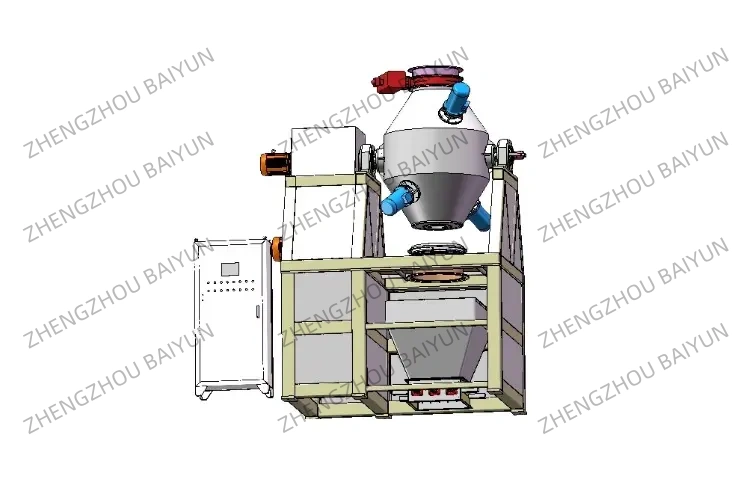
It delivers excellent loosening and dispersion effects for materials with disparate specific gravities and carbon-ceramic composite fibers without damaging fiber tensile strength or the morphological structure of raw materials, eliminating material agglomeration. The equipment ensures uniform dispersion of granular materials and ultrafine lightweight powders, stabilizing the friction performance of brake pads, guaranteeing consistent formulations for Baiyun brake pads, shortening mixing cycles, drastically cutting energy consumption and reducing manufacturing costs.
It overcomes the inherent drawbacks of vertical mixers and plow mixers widely adopted in the friction material industry, such as difficult cavity cleaning during material switching and high power consumption, making it an ideal piece of equipment for the friction material sector.
Manual feeding or automatic feeding systems can be connected to the top inlet, while an automatic mixture packaging system can be matched at the bottom discharge outlet.
Baiyun’s new three-dimensional mixer improves the homogeneity of raw material blending, cuts power consumption and production time by over 60%, generating remarkable economic benefits. With a daily mixing output of 20 tons, the savings on electricity and labor can offset the equipment investment within one year.
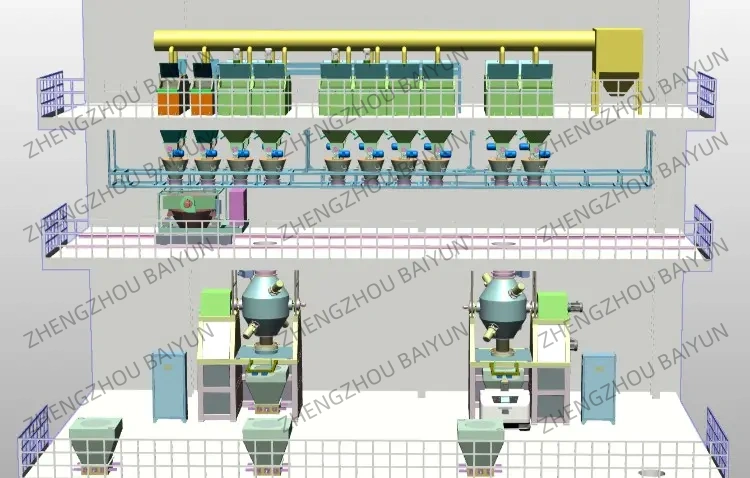
The mixer can be integrated with AGV intelligent material transport vehicles to realize positioning for feeding and discharging as well as intelligent material transfer, enabling fully intelligent circulation of mixed materials.
Raw materials must be added in strict sequence during mixing to achieve thorough homogeneous blending. Uniform mixing is mandatory, while bubble formation must be avoided. The compactness of materials shall be precisely controlled to prevent overheating. A water cooling system will automatically activate once excessive temperature is detected during operation.
A staged pre-mixing procedure can be adopted in the mixing process:
- First, pre-mix modified phenolic resin with modified carbon fibers, ceramic fibers and glass fibers to obtain Pre-mixture 1 with evenly dispersed components.
- Add expanded vermiculite, sepiolite powder, corundum powder, microcrystalline glass microspheres, zircon powder, coke powder and granular graphite powder into Pre-mixture 1 and blend uniformly to produce Pre-mixture 2.
- Incorporate potassium hexatitanate whiskers, bamboo charcoal powder and zinc oxide whiskers into Pre-mixture 2 and mix thoroughly.
Whatsapp number:+86 19937113563
Email:[email protected]