
Baiyun Brake Pad Mold has nearly 50 years of experience in brake pad mold manufacturing, design and R&D. Its products cover eight major series of pre-forming and hot-forming molds with various specifications and functions, including motorcycle brake lining molds, motorcycle brake pad molds, passenger car brake lining molds, passenger car brake pad molds, commercial vehicle brake lining molds,commercial vehicle brake pad molds, train brake shoe molds and wind power brake pad molds. Custom special supporting molds can be designed and manufactured according to customers’ different process requirements.
The factors of Baiyun brake pad mold design that affect brake pad forming accuracy mainly lie in mold structural design, material selection, temperature control system, exhaust system and manufacturing process precision. During brake pad production, the brake pad mold acts as a critical link between raw materials and finished products. Its design quality directly determines the dimensional accuracy, surface quality and internal structural uniformity of brake pads.
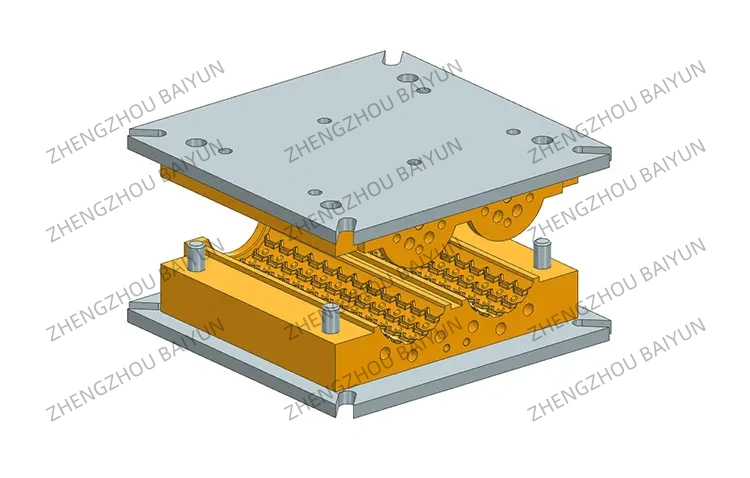
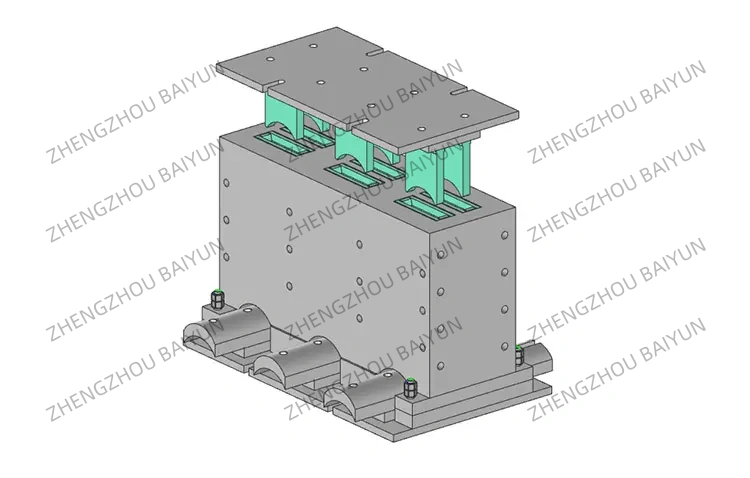

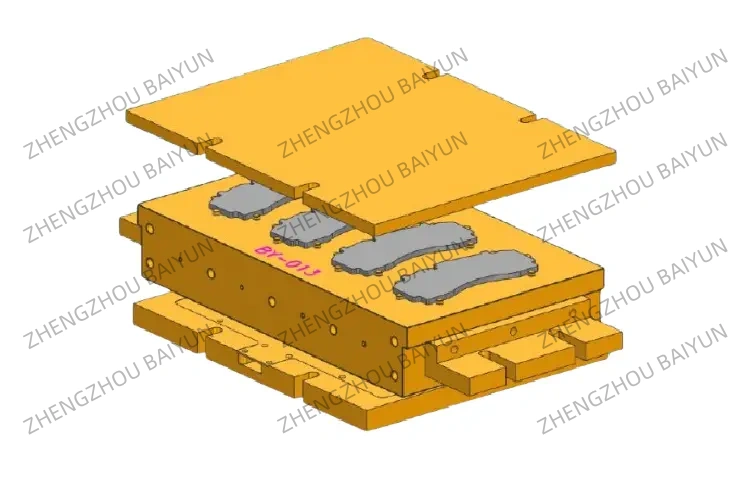
I.Mold Structural Design
The rationality of mold structure directly affects product forming accuracy and production efficiency. Proper clearance fit design ensures smooth mold separation during mold opening, and precision-ground machining dimensions guarantee product accuracy. The selection of mold core material is also crucial. High heat-resistant, wear-resistant and high-strength alloy steel or tungsten steel shall be adopted to maintain excellent mechanical properties and dimensional stability of the mold core under high temperatures. The mold guide system and positioning devices are also key factors affecting accuracy. An accurate guide system enables precise alignment of upper and lower molds, preventing dimensional deviations caused by misalignment.
II.Temperature Control System
The temperature control system is a core factor influencing brake pad forming accuracy. Molds are generally heated by resistance wires, heating rods and other components. Thermocouples, thermal resistors and other sensors monitor mold temperature in real time and feed data back to the temperature control system. The temperature fluctuation range of the control system shall be controlled within ±5°C to guarantee forming quality. The uniformity and stability of temperature directly determine the density, hardness and friction performance of brake pads. Uneven temperature distribution leads to inconsistent curing of raw materials and generates internal stress, which ultimately impairs the dimensional stability and service life of finished products.
III.Exhaust System Design
Exhaust system design exerts a vital impact on the internal quality of brake pads. Reasonably designed exhaust gaps prevent trapped gas from thermal pressing from causing internal defects in products. The design and fabrication of mold gaps shall be determined based on product formulation processes, product shapes, mold materials and other factors to ensure effective exhaust. A well-designed exhaust system can effectively reduce bubbles and pores inside products, improve compactness and mechanical strength, and stabilize overall product quality.
IV.Selection Standard of Brake Pad Mold Materials
Mold material selection has long-term impacts on forming accuracy. High-strength alloy steel, carbon steel, wear-resistant steel are commonly used as base materials. Their hardness must exceed that of brake pad friction materials, with outstanding heat resistance and toughness to avoid annealing, deformation or cracking under high-temperature conditions. The selection of wear-resistant layers also requires careful consideration. Surface treatment processes with high hardness and high precision are widely applied. The wear-resistant layer must be harder than the base material to enhance wear resistance, while maintaining strong bonding strength with the substrate to avoid peeling during service. Surface treatment of mold materials is also essential. Common treatments include nitriding, chromium plating and titanium plating, which greatly improve mold wear resistance and service life.
V.Precision Machining Technology in Manufacturing Process
Precision machining technology directly determines mold accuracy. High-precision CNC machine tools and machining centers are used for precision processing of mold parts to ensure manufacturing accuracy and surface quality. Appropriate cutting tools such as cemented carbide tools and ceramic tools are selected according to mold material, shape and processing requirements to boost machining efficiency and quality. Real-time monitoring and measurement are carried out throughout processing to detect and correct machining deviations promptly, ensuring consistent precision of all mold components. Mold assembly accuracy is equally important. The fit clearance and relative position of each component must be precisely controlled to secure the overall performance of the mold.
Impacts of Key Mold Design Factors on Brake Pad Forming Accuracy
| Design Factor | Technical Requirement | Influence Mechanism | Optimization Method | Impact on Product Quality |
| Mold Structure | Rational parting surface design | Affects product demolding and dimensional accuracy | 3D modeling and simulation analysis | Shape accuracy and surface quality |
| Temperature Control | Temperature fluctuation within ±5°C | Affects uniformity of material curing | Multi-zone temperature control system | Consistency of internal structure and performance |
| Exhaust System | Rational position and size of exhaust ports | Governs gas discharge efficiency | Flow simulation analysis | Internal compactness and mechanical strength |
| Material Selection | High heat resistance and high wear resistance | Affects mold service life and dimensional stability | Material performance testing | Long-term dimensional stability and service life of products |
| Machining Precision | Tolerance within ±0.01mm | Determines mold fit accuracy | High-precision processing equipment | Overall dimensional accuracy and batch consistency of products |
Whatsapp number:+86 19937113563
Email:[email protected]