
Baiyun has over 20 years of experience in the R&D and manufacturing of brake pad presses. We offer five major series of presses with various models and functions, including special presses for motorcycle brake pads, passenger vehicle brake pads, commercial vehicle brake pads, train brake shoes, and wind power brake pads.
The Baiyun press serves as the core equipment in brake pad hot press forming. Its technical parameters and performance directly determine the quality and functional performance of brake pads. Through high temperature and high pressure, the hot press molding machine compresses brake pad raw materials into finished brake pads with specified shapes and stable performance, thereby boosting vehicle braking capacity and driving safety. The operational precision and performance parameters of the brake pad press are among the critical factors governing brake pad quality.
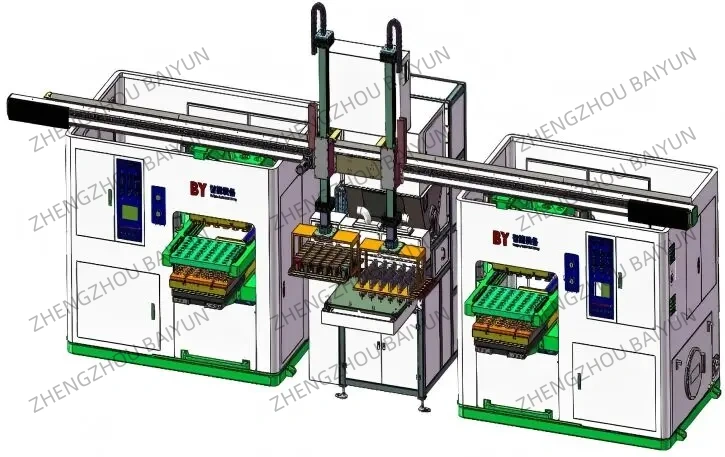
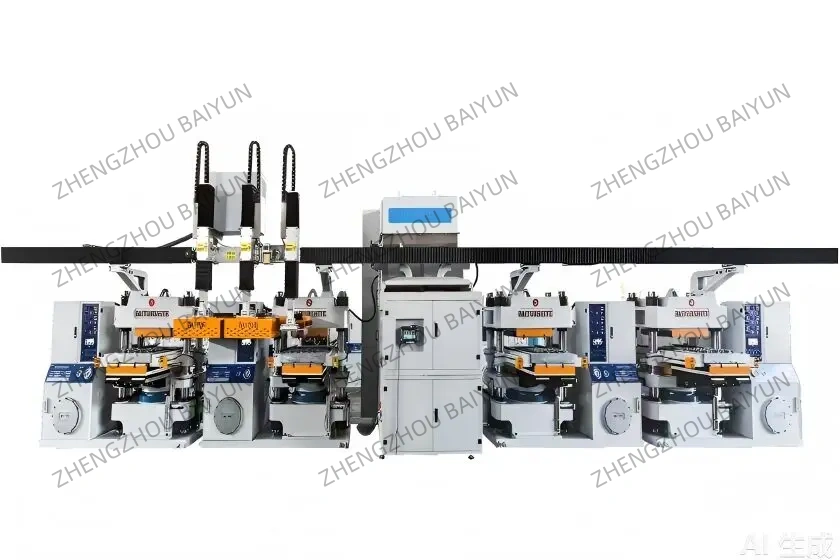
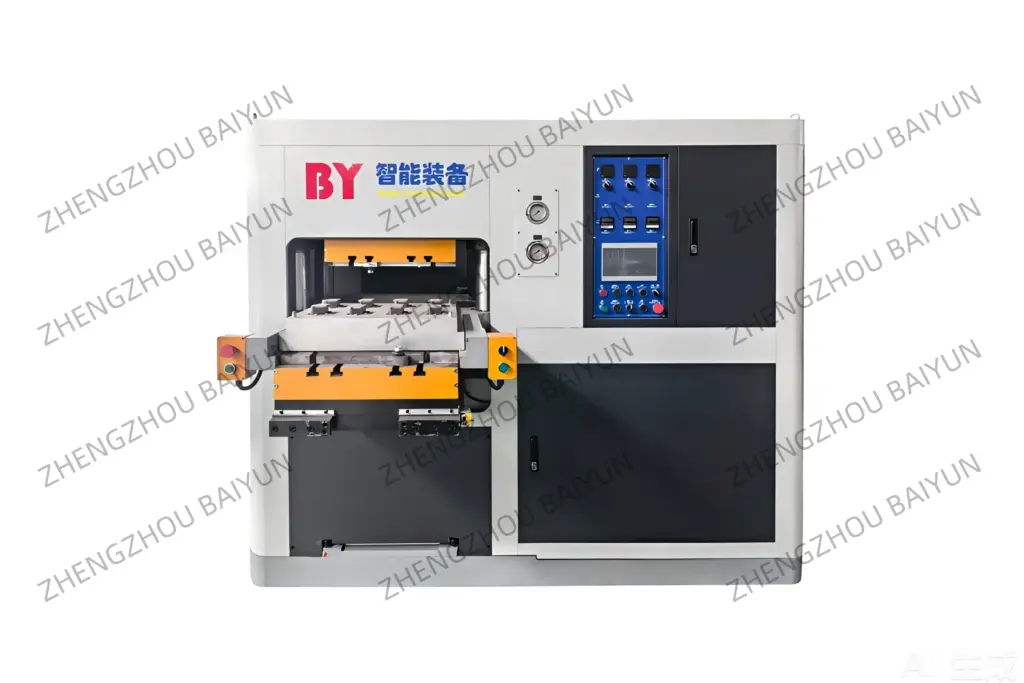
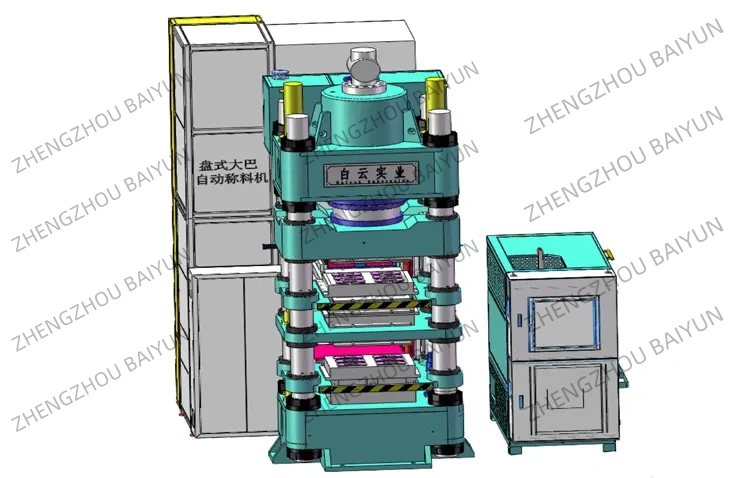
Core Technical Parameters of Baiyun Brake Pad Press
Key technical indicators include pressure range, pressure uniformity and pressurization rate.
- Pressure range: Adjustable within a wide band of 5–20 MPa, with specific values set according to material formulations and workpiece thicknesses.
- Pressure uniformity: Pressure deviation across the press table is controlled within ±5%, ensuring uniform compression of composite materials with uneven thickness.
- Pressurization rate: Supports fast pressurization at 20–50 kN/s. Synchronized pressurization with temperature rise is required during hot pressing to avoid deformation caused by softened preheated materials.
Precise regulation of these parameters guarantees uniform internal structure and consistent performance of finished brake pads.
Structural Types of Brake Pad Presses
Common structural forms include single-layer, double-layer and three-layer fixed four-column designs, as well as mold ejection structures.
- Four-pillar double-layer structure: A rigid frame assembled by upper and lower crossbeams connected via vertical pillars, delivering balanced pressure distribution and ideal for manufacturing large-size brake pads.
- Mold ejection structure: Features a large opening space and flexible operation, suitable for automated brake pad production.
The pressure execution system adopts a servo hydraulic circuit driven by pneumatic hydraulic cylinders, with a maximum tonnage up to 1,000 tons to meet the pressure requirements of all types of brake pad production.
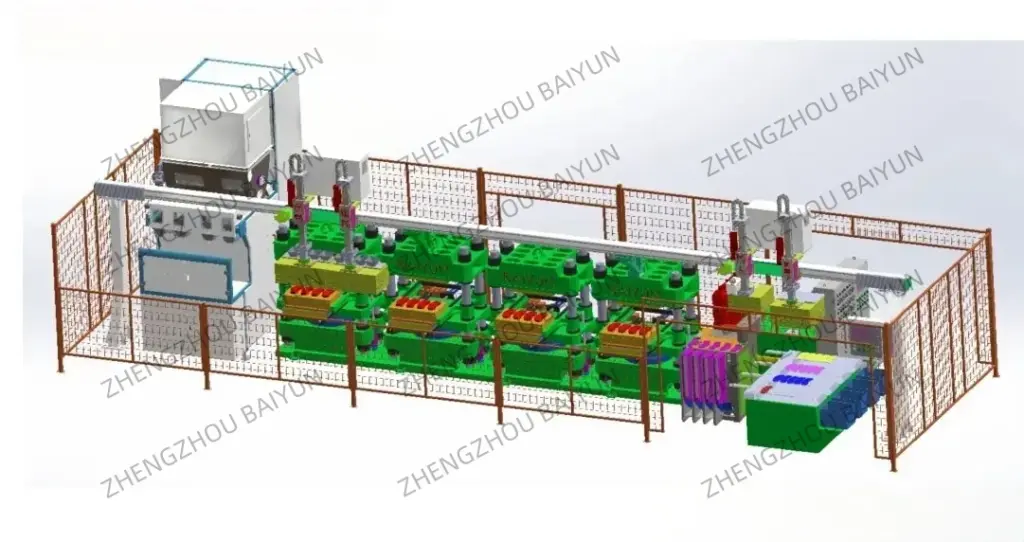
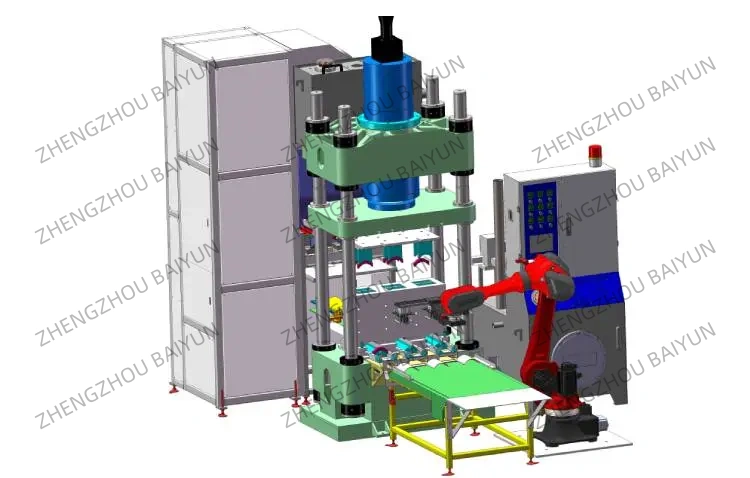
Core Functions of the Press in Hot Press Forming
- Ultra-precise positioning with a repeat accuracy of 0.01 mm enables even compression of raw materials, forming dense internal structures and improving wear resistance and braking performance.
- Coordinated operation with the temperature control system realizes high-temperature compression molding, endowing brake pads with superior wear resistance, high-temperature resistance and anti-fading properties.
- Matched dedicated brake pad molds accurately control brake pad thickness and surface smoothness, stabilizing braking force and ensuring even force distribution.
All above functions rely on the press’s precise control system and rigid mechanical framework.
Five Stages of the Hot Press Forming Cycle
The automated molding cycle consists of five programmable stages with network connectivity support:
- Automatic weighing and feeding
- Mold closing and pressurization (ramping pressure to 90% of the set value)
- Cyclic venting to eliminate internal air bubbles
- Pressure holding (maintaining target forming pressure)
- Mold opening and part removal (hydraulic retraction)
This high-precision molding capability delivers consistent thickness and geometry for every brake pad, stabilizing overall braking performance.
| Technical Parameter | Typical Value Range | Importance Level | Impact on Product Quality | Control Solution |
| Pressure Range | 5–20 MPa | High | Determines product density and structural uniformity | Precise hydraulic control system |
| Pressure Uniformity | Deviation ≤ ±5% | High | Ensures batch consistency of finished products | Optimized mold design and pressure distribution layout |
| Pressurization Rate | 20–50 kN/s | Medium | Governs material flow and bubble discharge efficiency | Servo control system |
| Temperature Control Accuracy | ±5℃ | High | Decides the completeness of material curing reaction | PID temperature regulation system |
| Forming Dimensional Accuracy | ±0.02 mm | High | Guarantees consistent product dimensions | Precision molds and positioning assembly |
| Pressure Holding Time | 300–400 s | Medium | Affects full curing of composite materials | Timing control module |
Figure 1 Main Technical Parameters of Brake Pad Hot Press Forming Presses, Their Significance and Impacts on Product Quality
Baiyun presses are equipped with integrated intelligent control systems capable of real-time parameter monitoring and adjustment. Certain models feature intelligent diagnostic modules that continuously track key indicators such as hydraulic oil temperature and heating plate temperature difference.
PLC programming enables multi-stage pressure adjustment, flexible pressurization and optional rapid vacuum auxiliary molding to enhance product compactness.
The intelligent system automatically records full production data and connects to MES systems to support full quality traceability, providing data foundation for process optimization. These technological upgrades not only raise production quality and efficiency of brake pads, but also strengthen manufacturers’ competitiveness and market advantages.
Selection Guidelines for Brake Pad Presses
Press selection depends on brake pad category, raw material formula and production batch volume:
Fully automatic high-efficiency presses are recommended for mass production of semi-metallic brake pads.
Semi-automatic flexible presses fit small-batch, multi-variety production of ceramic or carbon fiber brake pads.
Tonnage matching is also critical: insufficient tonnage leads to low product density, while excessive tonnage results in energy waste and unnecessary equipment investment.
In general, hot press tonnage ranges from 60 tons to 1,000 tons, selected according to workpiece dimensions, material characteristics and target production efficiency.
Whatsapp number:+86 19937113563
Email:[email protected]